
Search has come a long way from the early days of “ten blue links.”
Remember when Google used to look like this:
INSERT OLD IMAGE OF GOOGLE 2005
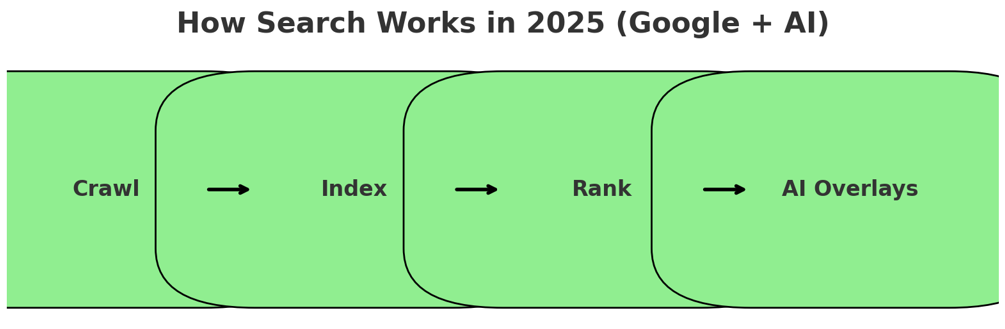
Today however, Google still crawls, indexes, and ranks web pages much the same way it always has — but it now layers artificial intelligence (AI) over the top to give users faster, more conversational answers; it gives users more helpful information.
Understanding how search works today helps you see why SEO matters and where to focus your efforts.
How Traditional Search Works
At its core, Google still follows the same three-step process:
- Crawling – Google’s bots (sometimes called “spiders”) scan the web, following links from one page to another to discover new or updated content.
- Indexing – When Google finds your page, it stores it in its massive database. Think of this as Google’s library of the web.
- Ranking – When someone searches, Google looks through its index to find the most relevant, trustworthy, and useful answers, then ranks them according to hundreds of signals (keywords, links, speed, usability, etc). In other words, it decides what are the most HELPFUL results and displays those at the top (i.e. they “rank” higher and so we have the “Google Rankings” which is a phrase you’ll commonly hear).
This traditional process remains the foundation of search.
What’s Changed: AI Overlays
Since 2023, Google has been rolling out AI Overviews and AI Mode:
- AI Overviews: Short, AI-generated summaries that appear at the top of search results, often above the standard web links. These aim to answer the question directly.
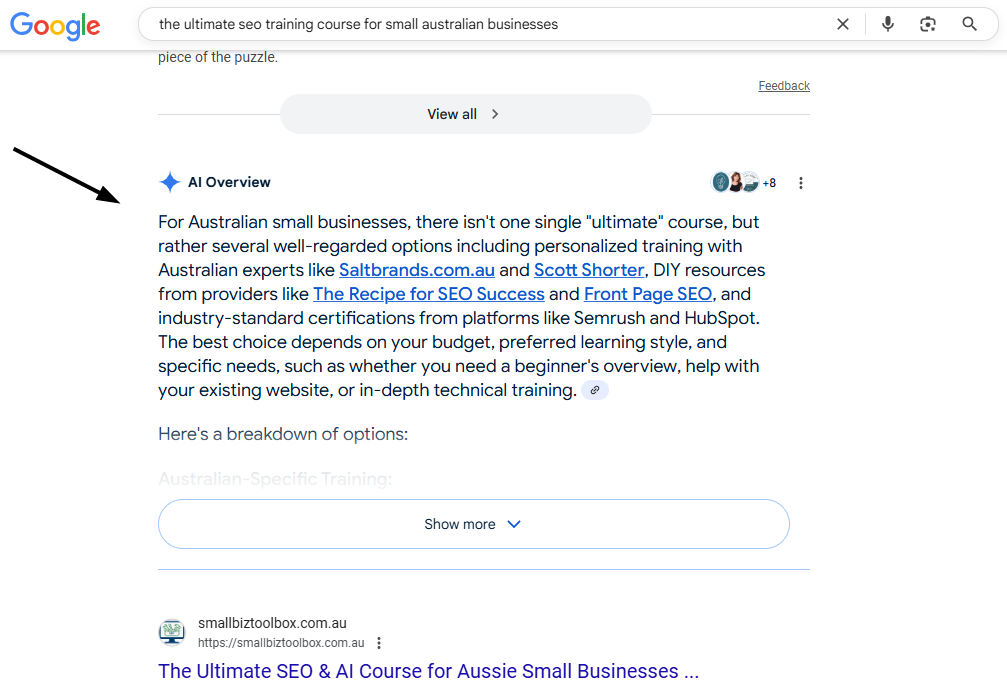
- AI Mode: A conversational search mode where users can type (or speak) more complex, follow-up questions. Google breaks queries into sub-topics, checks multiple sources, and pulls everything together into a detailed response.

This means your website may not only need to rank in the “traditional” list of results but also be cited by AI as part of its generated summary.
What AI Looks For
AI in search still relies on the fundamentals:
- Clear, well-structured content that directly answers user questions.
- Authority and trust signals such as links, reviews, and mentions.
- Technical health (speed, mobile-friendliness, indexability).
- Contextual relevance – how well your content matches the intent behind a search.
But now, it also prefers content that’s:
- Written in plain, natural language.
- Structured with headings, bullet points, and FAQs (easy to summarise).
- Backed up with context and sources.
Why This Matters for You
Your website’s visibility today is no longer just about being “number one on Google.” It’s about being discoverable in both places:
- Traditional search results (the links people still click).
- AI-generated answers (where trust and clarity matter most).
The good news: the same things that help you in traditional SEO — quality content, technical health, links, and trust — also increase your chances of being included in AI Overviews.
Action Step
- Do a test search: Open Google and search for a few of your main services or products (e.g., “plumber in Brisbane”, “best yoga studio Sunshine Coast”).
- Look carefully at the results:
- Do you see an AI Overview at the top?
- Which websites does it cite?
- Are they competitors, directories, or general information sites?
- Write down your observations in your SEO log (the one you started in Lesson 1). This will help you track how search is changing for your industry.

Need Help?
Go to our forum on this topic where other members or Ashley will help you.
Lesson outcomes
- Understand how traditional SEO works
- Understand what has changed with AI
- Understand what AI looks for
- Apply this to your website
Resources
None